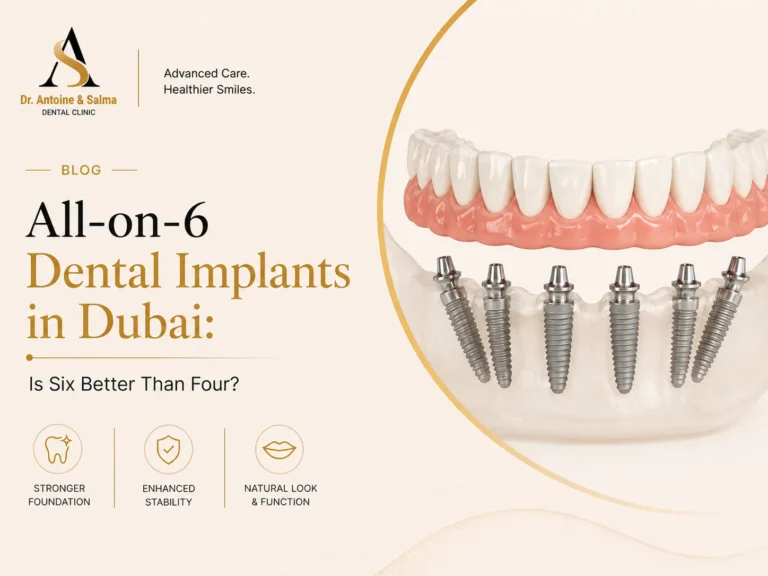
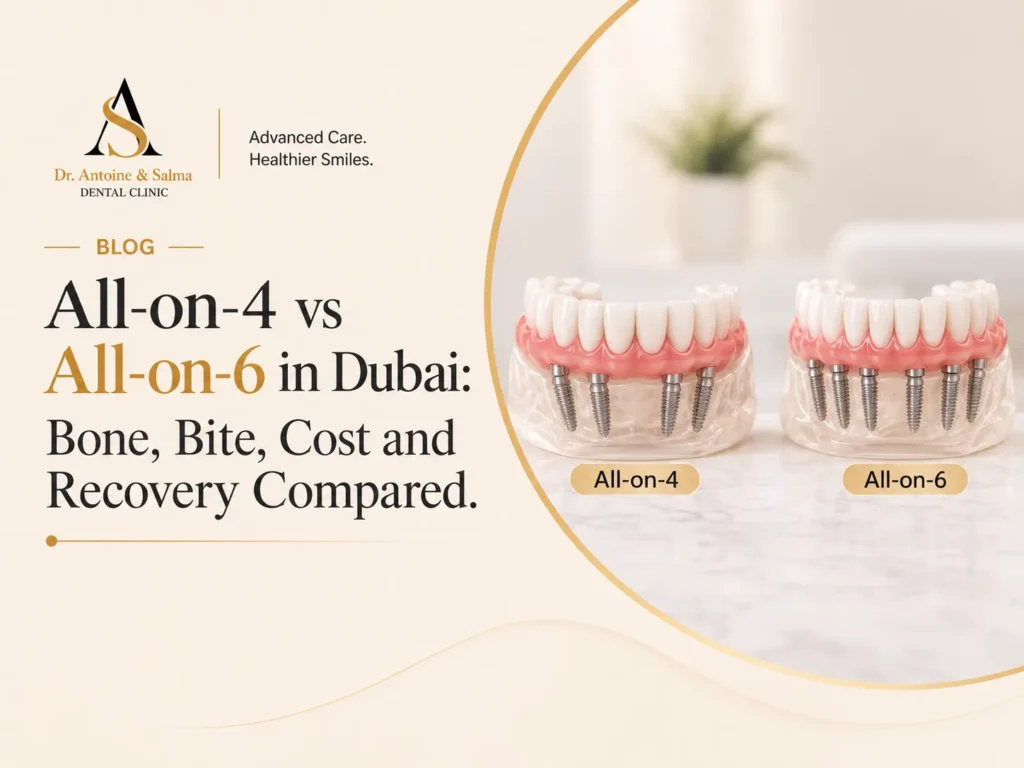
All-on-4 uses four implants per arch, often with the two rear implants tilted, while All-on-6 uses six implants for wider support. All-on-4 may suit patients with limited back-jaw bone, and All-on-6 may suit patients with enough bone and a strong bite. A CBCT scan and a bite assessment decide which one fits your mouth.
This guide compares All-on-4 vs. all-on-6 in Dubai across bone requirements, bite force, cost factors, and recovery. Use it to prepare the right questions before your consultation.
All-on-4 vs All-on-6 In Dubai: Difference Between The Two
All-on-4 supports a fixed full-arch bridge on four implants, usually with the two rear implants tilted to use available bone. All-on-6 uses six implants, placed more evenly along the jaw. Both replace an entire upper or lower arch of teeth with a non-removable prosthesis fitted on the implants.
Neither option is a removable denture. The real difference is how many implants carry the chewing load and where those implants sit in the jaw.
How All-on-4 Works
Dr. Paulo Malo developed the All-on-4 concept to rebuild edentulous jaws with fewer implants. Two implants go in at the front, standing straight. Two go in at the back, tilted. The angle lets each rear implant sit in firmer bone and reach farther along the jaw than a vertical implant could. In the upper jaw, this may help avoid a bone graft where the sinus limits bone height.
How All-on-6 Works
All-on-6 follows the same principle with two extra implants, spaced more evenly across the arch. The added implants share chewing force across more points. If one implant develops a problem, the others still support the bridge, although the bridge may need adjustment. Placement is usually closer to vertical, so it asks more of the available bone.
All-on-4 vs All-on-6 at a Glance
| Factor | All-on-4 | All-on-6 |
| Implants per arch | Four | Six |
| Rear implants | Usually tilted | Usually closer to vertical |
| Bone needed | Works with less rear bone | Needs suitable bone at six sites |
| Load distribution | Shared across four implants | Shared across six implants |
| Bridge cantilever | Often longer | Often shorter |
| Surgery time | Typically shorter | Typically longer |
| Cost | Typically lower | Typically higher |
Bone: Which Option Needs More Jawbone?
All-on-4 tolerates less bone at the back of the jaw. Its angled implants use the bone that remains in front of the sinus or the nerve canal. All-on-6 asks for usable bone at six positions, which is harder to find when the jaw has shrunk after years of tooth loss.
Your surgeon measures bone with a CBCT scan. It shows height, width, and density in 3D. The upper jaw (maxilla) is softer and often thinner than the lower jaw (mandible), so bone questions come up more often for upper arches.
Here is how bone level typically guides the choice:
- Good height and width: either option may be possible.
- Moderate loss at the back: All-on-4 with angled implants often fits.
- Severe loss: grafting, a sinus lift, or zygomatic implants may be discussed before or instead of a standard approach.
Bone density also matters. Dense bone can hold implants firmly enough for a fixed bridge on the day of surgery. Softer bone may call for a longer healing plan.
Bite and Load: Which Option Handles Chewing Better?
Chewing force travels through the bridge into the implants. With four implants, each one carries more load. The bridge may also extend past the last implant, a feature called a cantilever. Longer cantilevers increase stress on the rear implants and on the bridge itself.
Six implants allow a shorter cantilever and a more even load. Evidence suggests that a strong bite and bruxism (night grinding) raise mechanical risk for any full-arch bridge. Patients who grind may benefit from six implants, a durable bridge material, and a night guard.
Two bridge materials are common:
- Acrylic hybrid: lighter, easier to repair, and may wear faster.
- Zirconia bridge: stronger and stain resistant, usually at a higher cost.
Both are typically screw-retained, so your dentist can remove the bridge for cleaning or repair. Digital 3D guided implant planning maps implant angles and bridge shape before surgery. That plan helps the team match the implant count to your bite rather than guessing.
Cost in Dubai: What Changes the Price?
All-on-6 typically costs more than All-on-4 because it adds two implants and more surgical time. Per-arch prices in AED vary widely between clinics, so a flat number online rarely reflects your case. This article does not quote a single price for that reason. These factors move the estimate:
| Cost factor | Effect on your quote |
| Number of implants | Six implants cost more than four |
| Bone grafting or sinus lift | Adds a procedure when bone is limited |
| Bridge material | Zirconia usually costs more than acrylic |
| Implant system | Premium brands such as Straumann affect the implant cost |
| Sedation and imaging | CBCT, anesthesia, and sedation are priced separately in some clinics |
| Provisional bridge and follow-up | Should be listed in the plan, not added later |
Ask for an itemized estimate that covers the scan, surgery, provisional bridge, final bridge, and review visits. You can compare our All-on-4 dental implants in Dubai and All-on-6 dental implants pages for treatment details.
A&S Dental Clinic works on a fee-for-service basis. Patients can pay by cash, card, Apple Pay, Tabby, or Tamara. We provide itemized invoices to support reimbursement claims where your insurance plan allows.
How the All-on-4 and All-on-6 Process Works
Both treatments follow the same five steps:
- Consultation and CBCT scan confirm bone volume, gum health, and bite.
- Digital planning sets the implant number, angles, and bridge design.
- Surgery places the implants and, when conditions allow, a fixed provisional bridge.
- Healing and osseointegration take roughly three to six months as bone bonds to the implants.
- The final bridge replaces the provisional one once the gums and bone have settled.
Recovery: What to Expect
Swelling and bruising typically peak in the first two to three days and settle within one to two weeks. Most patients follow a soft diet for several weeks while the implants integrate. All-on-6 may involve slightly longer surgery, and recovery can feel longer in some cases, but both options follow a similar timeline.
Immediate loading, often called teeth in a day, means a fixed provisional bridge is attached on the day of surgery. It is one form of same-day implants. It depends on implant stability and bone quality at the time of surgery, so your surgeon confirms it during planning, not before.
Who Is a Candidate for Each Option?
The right choice depends on your anatomy and habits, not on which number is higher.
All-on-4 may suit you if:
- You have lost most of your teeth or have failing teeth in an arch.
- Rear bone is limited and you want to reduce the need for grafting.
- You prefer fewer implant sites.
All-on-6 may suit you if:
- You have enough bone for six implants.
- You have a strong bite or grind your teeth.
- You want added support across a long span, often in the upper arch.
Both options need healthy gums and controlled medical conditions. Heavy smoking and uncontrolled diabetes raise the risk of implant problems and are reviewed before surgery.
If bone is limited, your surgeon may recommend a graft first. Read what a dental bone graft involves before your visit, along with our page on sinus lift for the upper jaw. If you had earlier implants that loosened or became infected, you need a separate assessment. Our failed implant treatment page explains that route.
Long-Term Care and Risks
Both options carry similar biological risks. The main concerns are marginal bone loss around the implants and peri-implantitis, an infection of the gum and bone around an implant. Daily cleaning under the bridge is essential. Patients typically use a water flosser or interdental brushes as advised by the clinic.
To protect your investment:
- Attend review visits, usually every six months.
- Wear a night guard if you grind your teeth.
- Avoid smoking, which slows healing and raises infection risk.
- Report loose screws, bleeding, or a bad taste early.
A full-arch bridge is a long-term restoration, not a lifetime guarantee. Regular maintenance and follow-up reduce the chance of complications.
How to Choose a Clinic for Dental Implants in Dubai
Look for these markers when you compare dental implants in Dubai:
- A DHA-licensed surgeon you can verify.
- An on-site CBCT scanner and digital planning.
- The same team handling surgery and the final bridge.
- A written, itemized plan that names the implant system.
- A clear follow-up schedule.
At A&S Dental Clinic, Dr. Antoine Habib leads full-arch cases. He is a DHA-licensed Oral & Maxillofacial Surgeon with more than 20 years of clinical experience. He trained under Dr. Paulo Malo in All-on-4 and All-on-6 full-arch rehabilitation. The clinic uses a Carestream 9600 CBCT scanner and sits on Al Wasl Road in Al Manara, Dubai.
Book Your All-on-4 or All-on-6 Consultation
Your first visit includes an exam, a 3D scan, and a plan that shows which option fits your bone and bite. There is no need to decide on a number of implants beforehand.
- Call: +971 56 648 1481
- Hours: Monday to Saturday, 11:00 AM to 8:00 PM
- Book online: Book your appointment here.
Conclusion
All-on-4 and All-on-6 both give a fixed full-arch bridge. All-on-4 works well when rear bone is limited. All-on-6 adds support when bone and bite call for it. The deciding factors are your CBCT scan, bite force, and surgeon’s plan, not a standard rule. Book a scan, compare itemized plans, and choose the option your anatomy supports.
Frequently Asked Questions:
What is the main difference between All-on-4 and All-on-6?
All-on-4 supports a fixed arch on four implants, with the rear two usually tilted. All-on-6 uses six implants for wider support. The right choice depends on bone volume, bite force, and the jaw treated, confirmed by a CBCT scan.
Is All-on-6 better than All-on-4?
Not always. All-on-6 may suit patients with enough bone and a strong bite, while All-on-4 may suit limited rear bone. Neither is better for everyone. A scan and bite exam show which one fits your case.
How much do All-on-4 and All-on-6 cost in Dubai?
Pricing is per arch in AED and varies by clinic. All-on-6 usually costs more because it adds two implants and surgery time. Grafting, bridge material, and implant brand also change the quote. Ask for an itemized estimate after your scan.
Can I get All-on-4 or All-on-6 with little bone?
Sometimes. All-on-4 uses tilted implants to work with the bone you have. If bone is very limited, a bone graft, sinus lift, or zygomatic implants may be considered first. A CBCT scan shows what your jaw can support.
How long is recovery after All-on-4 or All-on-6?
Swelling and bruising usually settle in one to two weeks, and a soft diet is common for several weeks. Bone integrates with the implants over roughly three to six months before the final bridge. Timelines vary by case.
Do I get teeth on the day of surgery?
Many patients leave with a fixed provisional bridge, known as immediate loading or teeth in a day. It depends on implant stability and bone quality at surgery. Your surgeon confirms this during planning.