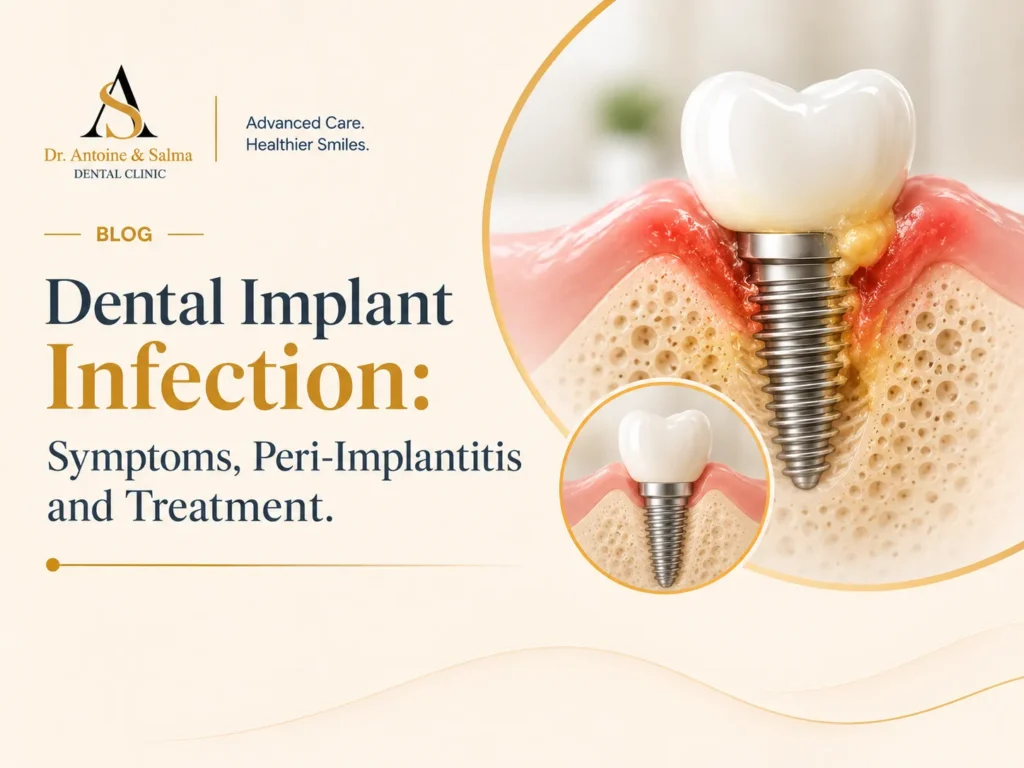
A dental implant infection is bacterial inflammation in the gum or bone around an implant. See a dentist when you notice bleeding, swelling, pus, a bad taste or any change in how the implant feels. At the gum stage the problem is usually reversible. Once bone is involved, treatment becomes more complex and the implant itself is at risk.
Many patients expect an infected implant to hurt. Often it does not, especially early on. That is why the quiet signs matter, and why this guide starts with them.
What Is a Dental Implant Infection?
A dental implant infection is bacterial inflammation in the gum or bone around an implant. It starts as peri-implant mucositis, which affects only the gum and is reversible. If it spreads to the bone, it becomes peri-implantitis, which can loosen the implant and may lead to failure without treatment.
Natural teeth are held by a ligament with its own blood supply and defenses. An implant sits directly in bone and lacks that ligament. Bacteria that gather along the implant surface can therefore trigger inflammation faster, and the tissue has fewer ways to fight back.
Published reviews estimate that peri-implantitis affects roughly one in five implant patients, and the milder gum-stage condition affects more. Figures vary between studies, but the pattern is consistent: this is a common complication, not a rare one.
How an Infected Implant Looks and Feels
Symptoms range from nearly invisible to obvious. Watch for these:
- Bleeding when you brush or floss around the implant
- Gums that look red, puffy or shiny near the crown
- Pus or a salty, metallic taste
- Persistent bad breath that brushing does not fix
- Tenderness when you bite or press on the area
- Gums pulling back so that implant threads or metal become visible
- An implant crown that feels loose or shifts
Pain tends to arrive late. Bone loss can progress for months with little discomfort, so a comfortable implant is not proof of a healthy one.
Early Infection vs. Late Infection
Timing helps point to the cause.
Early infection appears days to weeks after surgery. Common triggers include bacteria introduced during healing, poor early cleaning, or a healing site that was disturbed. Swelling, throbbing and discharge near the surgical site are typical.
Late infection appears months or years afterward. This pattern usually reflects plaque buildup, gum disease, bite overload or a problem with the crown. It is the form most patients meet.
Mucositis or Peri-Implantitis? Two Stages, Different Stakes
Dentists separate the condition into two stages because the outlook differs sharply. The table below shows how they compare.
| Feature | Peri-implant mucositis | Peri-implantitis |
| Tissue involved | Gum only | Gum and supporting bone |
| Typical signs | Bleeding, redness, mild swelling | Bleeding, pus, deeper pockets, visible bone loss on X-ray |
| Implant stability | Firm | May loosen as bone is lost |
| Reversible? | Usually, with professional cleaning and better home care | Bone loss does not heal on its own |
| Usual treatment | Non-surgical cleaning, antiseptic care | Often surgical cleaning, sometimes bone regeneration or removal |
The takeaway is simple. The gum stage is the window where treatment is easiest and results are most predictable.
Why Implants Get Infected
Infection rarely has one cause. Usually several factors stack up.
Plaque That Never Gets Disturbed
Bacterial biofilm clings to implant crowns the way it clings to teeth. Skip the gum line for a few weeks and the gum reacts. Bleeding then makes patients clean less, which feeds the cycle. If you are noticing bleeding gums elsewhere in your mouth too, our guide on what causes gums to bleed explains why brushing harder is not the fix.
A History of Gum Disease
Patients who lost teeth to periodontitis carry a higher risk. The same bacteria that harmed the natural teeth can colonize the implant. Treating gum disease before placement, and monitoring afterward, lowers that risk.
Smoking and Uncontrolled Diabetes
Smoking narrows blood vessels and slows healing. Poorly controlled blood sugar weakens the immune response. Both are well documented risk factors, and both are worth discussing with your dentist before surgery, not after a problem appears.
Crown and Cement Problems
Excess dental cement left under the gum can irritate tissue for years. A crown that is hard to clean around, or one that sits at an awkward angle, creates the same trap for plaque.
Bite Overload
Grinding or clenching places heavy force on the implant and surrounding bone. Overload alone may not cause infection, but it can speed bone loss once inflammation starts.
Not Enough Bone or Gum Support
Implants placed where bone or healthy gum is thin have less protection. If grafting was done earlier and did not hold, see our article on a failed dental bone graft for what that means for implant planning.
Who Should Be Most Alert?
| Risk factor | Why it matters | Practical step |
| Previous gum disease | Same bacteria can colonize the implant | Closer maintenance schedule |
| Smoking | Reduces blood flow and healing | Cut back or stop, ideally before surgery |
| Diabetes | Slower healing, higher infection tendency | Keep blood sugar controlled |
| Teeth grinding | Overloads bone around the implant | Night guard if advised |
| Missed check-ups | Early signs go unnoticed | Keep visits on the calendar |
How a Dentist Confirms the Diagnosis
Confirmation does not rely on one test. Expect a combination of the following:
- Clinical exam: The dentist checks for redness, swelling, bleeding and discharge.
- Gentle probing: A thin instrument measures pocket depth around the implant. Deeper pockets and bleeding on probing point to active disease.
- Imaging: X-rays show bone height. A 3D cone beam CT scan shows the bone around the implant from every angle, which helps plan treatment when bone loss is suspected.
- Bite and crown review: The fit of the crown and the way your teeth meet are checked, since both can drive the problem.
Do not try to self-diagnose from photos online. Early peri-implantitis and healthy tissue can look similar, and only measurement and imaging separate them.
Dental Implant Infections: Treatment by Stage
Treatment follows the stage and the amount of bone lost. No single method has proven consistently superior in long-term studies, so plans are individualized.
Stage 1: Gum Inflammation Only
The dentist removes plaque and calculus from the implant surface using instruments designed not to scratch titanium. Antiseptic rinses may be added. You receive coaching on cleaning tools that fit around the crown, such as interdental brushes. A recheck follows within weeks.
Stage 2: Early Bone Involvement
Non-surgical cleaning is tried first, but it often falls short once bone is affected. Evidence suggests that mechanical cleaning alone is less effective for established peri-implantitis than for mucositis. Antibiotics may support treatment in selected cases. They rarely resolve the problem on their own, because bacteria sit in a film on the implant surface.
Stage 3: Established Bone Loss
Surgery is usually needed. The dentist lifts the gum, cleans the implant surface directly, removes infected tissue and, where the defect shape allows, may rebuild bone with graft material. Where the crown design is part of the problem, it may be reshaped or replaced. Outcomes vary, and long-term monitoring is part of the plan.
Stage 4: When the Implant Cannot Be Saved
If the implant is loose or most of its support is gone, removal is the safer course. The site then heals, and bone may be rebuilt before a new implant is considered. Patients in this position can read more about failed implant treatment and implant revision options.
| Stage | Main goal | Typical approach | Recovery feel |
| Gum-only | Reduce inflammation | Professional cleaning, home care changes | Minimal downtime |
| Early bone loss | Stop progression | Deep cleaning, possible antibiotics, close monitoring | Mild soreness |
| Established bone loss | Clean and stabilize | Surgical cleaning, possible bone regeneration | Several days of swelling and tenderness |
| Failed implant | Remove infection and rebuild | Removal, healing, grafting if needed | Longer, planned in phases |
Is It Infection, or Something Else?
Not every sore spot near an implant is an infection. Short, sharp sensitivity to cold can come from neighboring natural teeth, and our piece on tooth sensitivity helps sort out the difference. A loose-feeling crown may be a loose screw rather than a loose implant. Food trapped under a bridge can inflame gums within days.
These look-alikes are fixable, but they still need a dentist to rule infection in or out. Waiting to see if it settles is the habit that turns a gum problem into a bone problem.
What to Do If You Suspect an Infection
- Book a check-up promptly. Bleeding or tenderness that lasts more than a few days deserves an exam.
- Get same-day care for red flags. Pus, facial swelling, fever or a visibly moving implant should be seen quickly.
- Keep cleaning. Brush gently around the implant with a soft brush. Avoiding the area lets plaque build up.
- Avoid picking at it. Do not press, pry or test the implant yourself.
- Hold off on smoking. Smoke slows the tissue’s ability to recover.
- Do not start leftover antibiotics. They can mask symptoms and do not treat the cause on their own.
Keeping an Implant Healthy for the Long Term
Prevention is mostly routine:
- Clean twice daily and use interdental brushes or a water flosser around the crown
- Attend professional maintenance visits, usually every three to six months for implant patients
- Keep gum disease and diabetes under control
- Wear a night guard if you grind your teeth
- Report bleeding early rather than waiting for it to stop
Choosing the right clinician matters too. Look for a dental implantologist in Dubai who plans with 3D imaging, explains maintenance clearly and keeps the same team involved from surgery through follow-up.
Before You Call the Clinic: A Quick Note Sheet
A short note can make your first visit far more productive. Jot down:
- When you first noticed the change, and whether it is getting better or worse
- Where on the implant it shows up (gum line, under the crown, one side only)
- Any bleeding, taste, odor or pus, and how often
- When the implant was placed and who placed it, plus any prior X-rays you hold
- Medicines you take and any smoking or health conditions the dentist should know
Bring this to your appointment at A&S Dental Clinic in Al Manara, Dubai. The team will examine the implant, review a 3D scan if needed and give you a written plan with the cost explained before any treatment starts. Contact us to book your appointment.
Conclusion
A dental implant infection is common, often painless in its early stages and most manageable when found at the gum stage. Bleeding, swelling, pus or a change in how an implant feels are reasons to book an exam rather than wait. With a clear diagnosis, stage-appropriate treatment and steady maintenance, many infected implants can be stabilized, and those that cannot be saved can be replaced after proper healing. This article is general information and does not replace a clinical consultation.
Frequently Asked Questions
1. Can an infected dental implant be saved?
Often, yes, when treated early. Gum-stage infection usually resolves with professional cleaning and better home care. Once bone is lost, surgery may stabilize the implant, though outcomes vary and some implants must be removed.
2. What are the first signs of a dental implant infection?
Bleeding when brushing, redness, swelling, a bad taste or bad breath around the implant are common early signs. Pain is often absent at first, so routine check-ups matter even when the implant feels fine.
3. Is a dental implant infection an emergency?
Pus, spreading facial swelling, fever or a loose implant need prompt dental attention, ideally the same day. Mild bleeding or tenderness should be checked within days. Do not wait for pain to build.
4. How is peri-implantitis treated?
Treatment depends on stage. Early cases need professional cleaning and antiseptic care. Advanced cases may need surgical cleaning, bone regeneration or implant removal. Antibiotics alone rarely solve bone-level disease.
5. Can an implant get infected years after placement?
Yes. Peri-implantitis can appear months or many years after placement, often linked to plaque buildup, smoking, gum disease history or an ill-fitting crown. Regular maintenance visits help catch it early.
6. How much does dental implant infection treatment cost in Dubai?
Cost depends on severity, from a cleaning visit to surgery. A clinical exam and 3D scan confirm the plan, and a written quote follows. Ask what each stage includes before you start.